
The Pepsi Challenge: The Marketing Campaign That Changed Soft Drink History
For decades, Pepsi has been recognized as one of the world’s leading beverage brands. While the company has launched hundreds of successful advertising campaigns, one marketing idea stands above the rest: The Pepsi Challenge.
Introduced in the 1970s, this simple yet revolutionary campaign transformed the soft drink industry and became one of the most influential marketing strategies in history. Rather than relying solely on traditional advertising, Pepsi allowed consumers to decide which drink tasted better through blind taste tests.
The campaign not only increased Pepsi’s market share but also forced competitors to rethink their own marketing strategies.
What Was the Pepsi Challenge?
The Pepsi Challenge was first introduced in 1975 across the United States.
The concept was surprisingly simple:
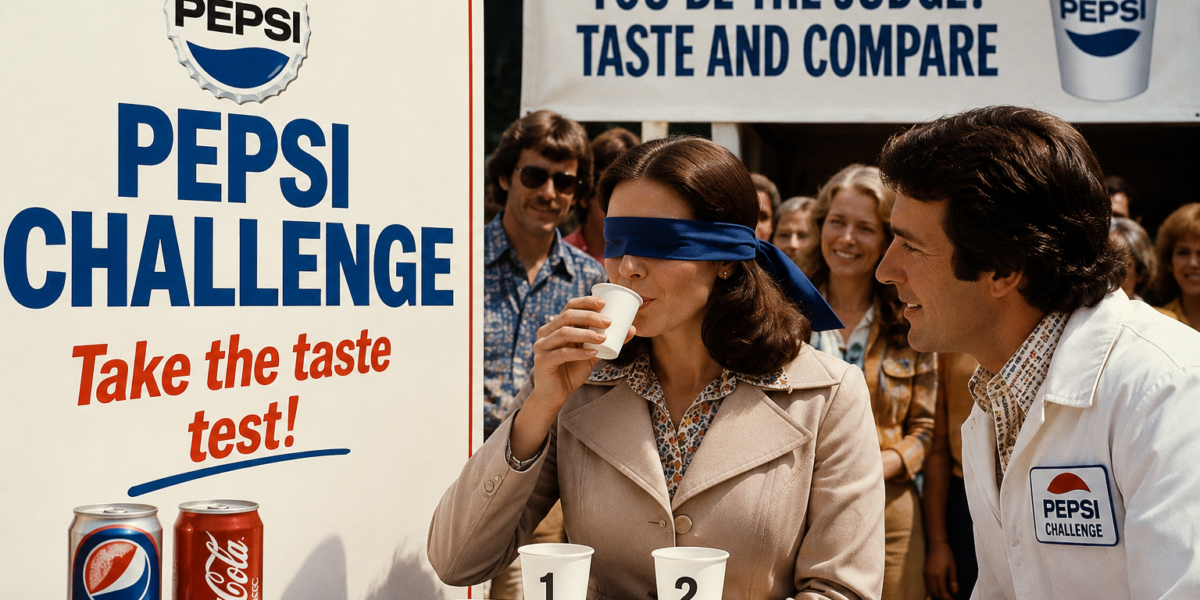
Customers were invited to participate in a blind taste test between two unmarked cups—one containing Pepsi and the other containing Coca-Cola. Participants had no idea which brand they were tasting.
After trying both drinks, they were asked a simple question:
“Which one tastes better?”
To the surprise of many consumers, a large percentage selected Pepsi.
Why the Campaign Was Revolutionary
At the time, Coca-Cola dominated the soft drink market and enjoyed decades of brand loyalty.
Pepsi understood that convincing customers through advertising alone would be difficult.
Instead, the company let consumers experience the product for themselves.
This shifted the marketing message from:
“Trust what we say.”
to
“Trust your own taste.”
That change made the campaign incredibly persuasive.
The Psychology Behind the Success
The Pepsi Challenge succeeded because it relied on several powerful psychological principles.
1. Social Proof
Seeing ordinary people choose Pepsi created trust and credibility.
Customers believed the results because they watched real participants making real decisions.
2. Curiosity
People naturally wanted to know whether they could tell the difference between Pepsi and Coca-Cola.
This curiosity encouraged thousands of people to participate voluntarily.
3. Interactive Marketing
Instead of watching a commercial, customers became part of the campaign.
This direct interaction created stronger emotional connections with the brand.
4. Product Confidence
Pepsi demonstrated confidence by allowing customers to judge the product without branding or packaging influencing their decision.
The campaign focused entirely on the product experience.
Media Coverage
The Pepsi Challenge quickly became a national event.
Television stations, newspapers, and magazines covered the taste tests, giving Pepsi millions of dollars worth of free publicity.
Word-of-mouth marketing spread rapidly as participants shared their experiences with friends and family.
Business Results
The campaign significantly increased Pepsi’s visibility and helped the company gain market share in several regions.
More importantly, it positioned Pepsi as a serious competitor capable of challenging Coca-Cola’s long-standing dominance.
The campaign became one of the most recognized marketing initiatives in advertising history.
The Coca-Cola Response
The success of the Pepsi Challenge placed enormous pressure on Coca-Cola.
During the 1980s, the company invested heavily in market research and eventually introduced New Coke in 1985—one of the most controversial product launches in business history.
Although New Coke was ultimately unsuccessful, many marketing experts believe the Pepsi Challenge played an important role in influencing Coca-Cola’s decision to reformulate its flagship product.
Marketing Lessons from the Pepsi Challenge
Businesses of every size can learn valuable lessons from this campaign.
- Let customers experience your product.
- Build trust through transparency.
- Encourage customer participation.
- Create memorable brand experiences.
- Focus on product quality rather than advertising alone.
- Generate conversations that people naturally want to share.
- Turn customers into brand advocates.
Why the Pepsi Challenge Still Matters Today
Even decades later, marketers continue to study the Pepsi Challenge because its principles remain highly relevant.
Modern brands now use product demonstrations, free trials, influencer reviews, customer testimonials, and interactive experiences—all strategies that reflect the same idea Pepsi introduced nearly fifty years ago.
The campaign proved that authentic customer experiences can be more persuasive than traditional advertising.
Conclusion
The Pepsi Challenge remains one of the greatest marketing campaigns ever created. By replacing conventional advertising with real customer experiences, Pepsi reshaped consumer perceptions and challenged one of the world’s most powerful brands.
Its success demonstrates that innovative marketing is not always about having the biggest budget—it is about creating memorable experiences that allow customers to discover the value of a product for themselves.